
Understanding your menstrual cycle is about much more than just knowing when your period will arrive. It’s a complex, beautifully orchestrated hormonal balance that affects your energy, mood, and overall health. When these hormones are in balance, your body functions well; when they aren’t, it can lead to conditions like PCOS.
Here is a deep dive into the four primary hormones that rule your cycle and how they differ in a normal versus a PCOS-affected body.
will arrive. It’s a complex, beautifully orchestrated “hormonal dance” that affects your energy, mood, and overall health. When these hormones are in balance, your body functions like a well-oiled machine; when they aren’t, it can lead to conditions like PCOS.
Here is a deep dive into the four primary hormones that rule your cycle and how they differ in a normal versus a PCOS-affected body.
The Four Key Hormones
1. FSH: The Follicle Stimulator
Follicle-Stimulating Hormone (FSH) is the hormone that kicks everything off. Produced by the pituitary gland, its primary role is to tell your ovaries to “wake up” and begin growing follicles (the tiny sacs that contain your eggs).
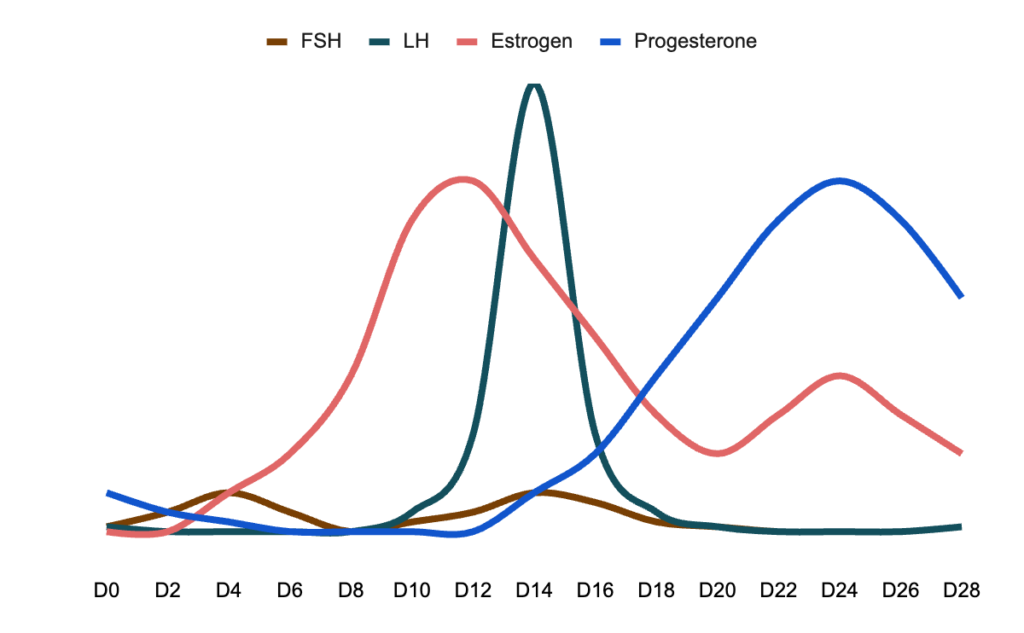
- When it peaks: Usually between Day 4–6 of your cycle.
- Why it matters: Without FSH, the process of egg maturation never begins. It is the catalyst for the entire monthly journey.
2. Estrogen: The Builder
As those follicles grow, they begin to produce Estrogen. Eventually, one follicle becomes “dominant,” producing high levels of this hormone. Estrogen’s main job is to thicken the uterine lining to prepare for a possible pregnancy.
- When it peaks: Around Day 10–12, just before ovulation.
- The Signal: Rising estrogen levels act as a green light for the brain, signaling it to release the next hormone in the sequence: LH.
3. LH: The Ovulation Trigger
Luteinizing Hormone (LH) is responsible for the main event: ovulation. A dramatic surge of LH causes the ovary to release a mature egg from its follicle.
- When it peaks: Between Day 12–14. This surge typically lasts 24–36 hours, creating your “fertile window.”
- Why it matters: No LH surge means no ovulation. If this hormone doesn’t spike, the egg remains trapped in the ovary.
4. Progesterone
After the egg is released, the empty follicle shell—now called the corpus luteum—starts producing Progesterone. This hormone prepares the body for potential pregnancy and has a “calming” effect on the system.
- When it peaks: Around Day 22–26.
- Why it matters: Progesterone signals the brain to stop producing LH. It maintains the uterine lining and ensures the cycle concludes properly.
The Perfect Harmony: A Balanced Cycle
In a healthy, balanced cycle (typically 28 days), these hormones work in a specific sequence:
- Days 1–5: FSH rises; follicles begin to grow.
- Days 6–12: Estrogen rises as the dominant follicle develops.
- Days 12–14: LH rises sharply, triggering ovulation.
- Days 16–24: Progesterone rises to prepare the body for pregnancy.
What Happens in a PCOS Cycle?
Polycystic Ovary Syndrome (PCOS) disrupts this delicate sequence. Because a dominant follicle often fails to develop, the hormonal “domino effect” gets stuck.
The PCOS Chain Reaction:
- No dominant follicle means there is only a small increase in estrogen.
- LH stays high but never “surges.” Because the brain doesn’t see a sharp spike, it doesn’t trigger the egg’s release.
- No egg release means no progesterone increase.
- No progesterone means the brain never gets the signal to stop producing LH, so LH levels remain high and stagnant.