
There is a common belief that if you want more muscle, you need more protein. We have all seen the gym veterans lugging around massive tubs of whey. But does the science actually support the “more is better” philosophy? As it turns out, your body has a very specific “ceiling” for how much protein it can actually use to build muscle. If you are eating beyond that limit, you aren’t really building more muscle.
So, what Does the Science Actually Show?
To find the truth, we look at the gold standard of research: meta-analysis. A comprehensive review of 49 studies covering over 1,800 individuals (ranging from casual gym-goers to elite athletes) looked at the relationship between protein supplementation and muscle mass increase measured as fat free mass increase (see Image 1 below). The research shows that there is a clear point of diminishing returns.
The Magic Number: 1.6g/kg of ideal body weight per day
The research indicates that 1.6 grams of protein per kilogram of ideal body weight per day is the “sweet spot” for peak muscle growth. Infact, 1.2 – 1.6 g/kg of ideal body weight per day is the optimal range for most people to see consistent gains. Beyond 1.6 g/kg, muscle protein synthesis reaches a plateau.
The Plateau Effect: When we look at Fat-Free Mass (FFM) increases as a surrogate for muscle protein synthesis or muscle mass increase compared to protein intake, the graph tells a clear story:
0.8 – 1.2 g/kg: Rapid increase in muscle mass.
1.2 – 1.6 g/kg: Continued upward trajectory.
1.6 – 2.0 g/kg: The curve flattens significantly.
2.0 g/kg: The line stays flat.
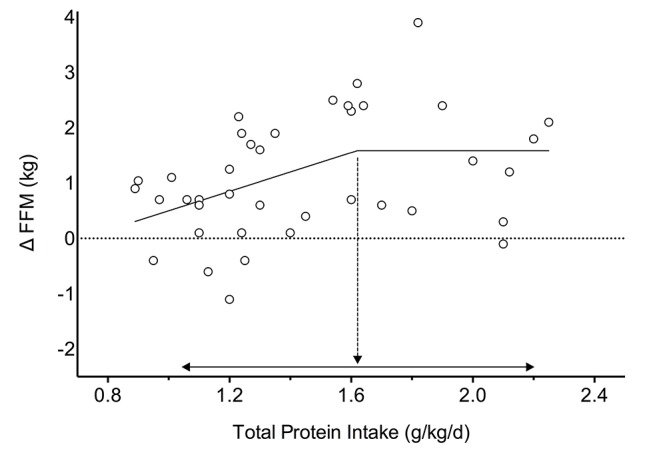
Image 1: Fat Free Mass increase plateaus after 1.6 g / kg / day of protein intake
Note: These calculations should be based on your Ideal Body Weight (calculated at an ideal BMI of 22.5 based on your height), not necessarily your current scale weight if you are carrying significant body fat.
Most people overestimate how much protein they actually need. So, for someone with a height of 5’2″, the ideal body weight is 55 kg and ideal protein requirement per day is 66 g to 88 g per day; ideally spread equally across 3 meals of the day for maximum benefit. Likewise, for someone with a height of 5’10”, the ideal body weight is 71 kg and ideal protein requirement per day is anywhere from 85 g to 114 g per day
While a lot is said about getting adequate protein, truth is unless there is resistance training coupled with that, muscle strength does not show any increase. If you aren’t challenging your muscles through lifting weights or bodyweight resistance, a high-protein diet will lead to minimal gains in actual strength. Protein is the building block, but training is the real driver of impact. Both matter, but the training matters more.
You can have a “perfect” protein intake, but without the right stimulus, there is no real gain in muscle strength. Resistance training matters more than protein.
Follow these three simple steps:
-
Calculate Your Target: Find your ideal body weight taking BMI as 22.5 and multiply the output by 1.6 to find your daily “ceiling.” in terms of protein your body needs
-
Eat Whole Foods First: Focus on high-quality sources like chicken breast, fish, paneer, and dals. Use supplements like whey protein intelligently—only if you can’t hit your target through meals.
-
Focus on the Lift: Prioritize a consistent, challenging resistance training program.
Stop buying “whey” more protein than you actually need.
References:
-
A systematic review, meta-analysis and meta-regression of the effect of protein supplementation on resistance training-induced gains in muscle mass and strength in healthy adults (https://pmc.ncbi.nlm.nih.gov/articles/PMC5867436/#s5)
-
The effects of creatine and whey protein supplementation on body composition in men aged 48 to 72 years during resistance training (https://www.sciencedirect.com/science/article/pii/S127977072302047X)
-
Phillips SM, Chevalier S, Leidy HJ. Protein “requirements” beyond the RDA: implications for optimizing health. Appl Physiol Nutr Metab 2016;41:565–72. 10.1139/apnm-2015-0550 (https://cdnsciencepub.com/doi/full/10.1139/apnm-2015-0550)
Disclaimer: The content on “www.pathyahealth.com” is for informational and educational purposes only and does not constitute professional medical advice, diagnosis, or treatment. Always seek the advice of your physician regarding any medical condition.